
Newman Zone EVO Supported Treatment of a 6,000-Foot TCE Plume Without Disrupting Military Operations
Dover Air Force Base in Delaware faced a large TCE plume created by historical releases of degreasing solvents used during aircraft maintenance. Accelerated anaerobic bioremediation and a system of direct-injection and circulating biobarriers reduced the plume area and contaminant mass while allowing military operations to continue.
A 6,000-Foot TCE Plume at an Active Air Force Base
Since World War II, Dover Air Force Base has served as a major center for military air-cargo operations in the eastern United States. Degreasing solvents were routinely used for aircraft maintenance, and historical releases resulted in extensive groundwater contamination.
Area 6 contained the largest contaminated groundwater plume identified at the base. The TCE plume extended approximately 6,000 feet and covered about 300 acres within a shallow surficial aquifer. The primary contaminants of concern were trichloroethene (TCE), dichloroethene (DCE), and vinyl chloride.
Accelerated anaerobic bioremediation was selected in 2006 to treat the source areas and the core of the dissolved plume.
TCE Plume Treatment Challenges
Any groundwater remediation work at the site had to be completed without interfering with ongoing military operations. Buildings, asphalt, concrete, and other existing infrastructure limited access to potential injection locations.
Subsurface conditions also complicated treatment. The TCE plume was present in unconsolidated deposits containing clay, silt, sand, and gravel. This mixture of fine- and coarse-grained materials made uniform electron donor distribution difficult.
An effective treatment system needed to deliver food for microorganisms throughout the contaminated groundwater while limiting the number of injection points required across the active base.
Accelerated Anaerobic Bioremediation Using Biobarriers
The treatment design used two different types of biobarriers. Direct injection of electron donor products was used in the source areas and in two direct-push injection treatment biobarriers.
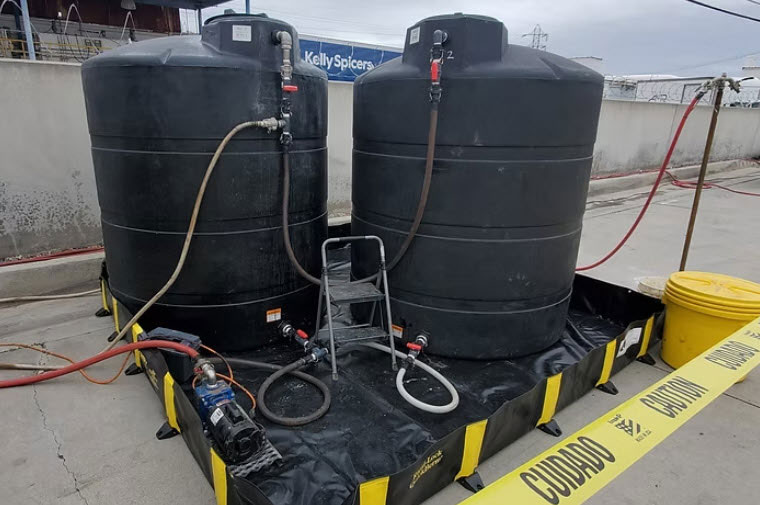
Nine additional biobarriers used circulation between permanent wells. Groundwater was pumped between the wells to distribute the electron donor across each treatment transect. This approach reduced the number of injection locations needed and allowed the treatment system to operate around buildings, pavement, and other infrastructure.
As contaminated groundwater moved through the biobarriers, the electron donor supplied food for microorganisms performing reductive dechlorination.
Newman Zone EVO Improves Electron Donor Distribution
Performance problems with other products led the project team to begin using Newman Zone EVO in the permanent-well circulating biobarriers in 2007.
Newman Zone EVO provided improved electron donor distribution with minimal loss of hydraulic conductivity. Maintaining hydraulic conductivity was particularly important because the permanent biobarriers depended on groundwater circulation to move the electron donor through the treatment area.
According to the original case study:
“The smaller droplet size is more mobile and doesn’t clog the wells as much as other products.”
The mobility of the small oil droplets helped distribute Newman Zone EVO through the heterogeneous aquifer while allowing the circulating wells to continue functioning effectively.
Evidence of Complete TCE Dechlorination
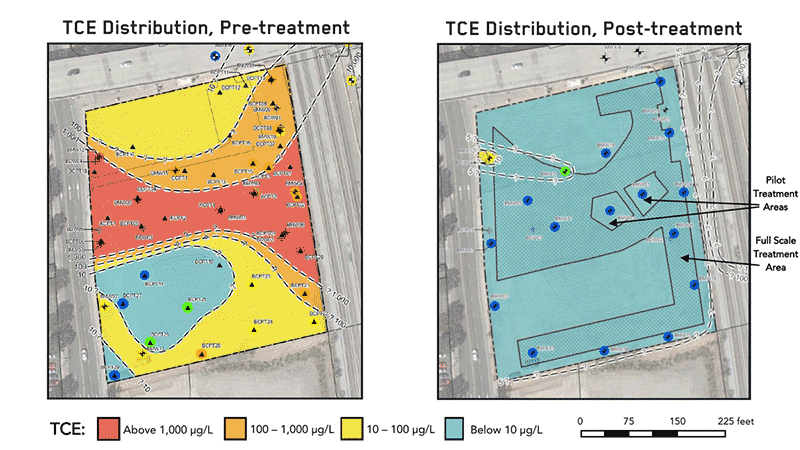
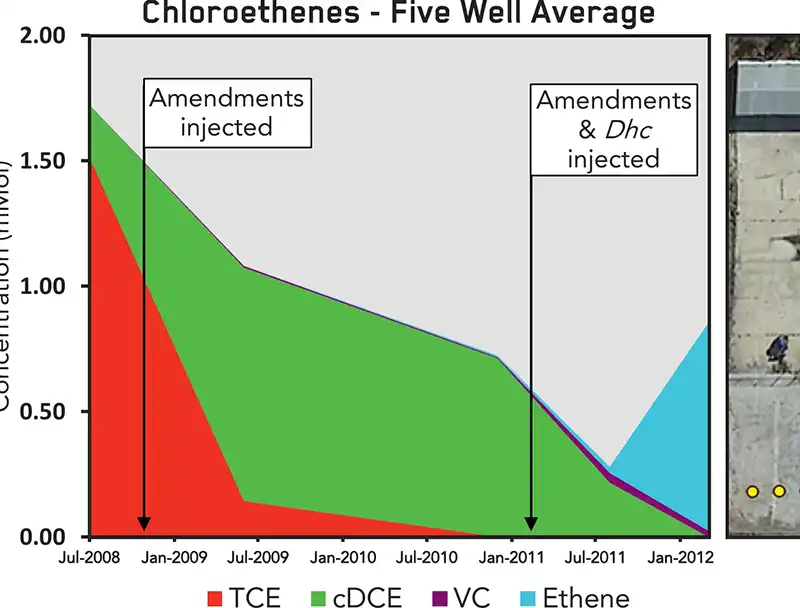
Treatment produced a large reduction in both TCE plume area and contaminant mass. Monitoring detected increases in DCE and vinyl chloride, followed by an increase in ethene.
These changes are important because TCE is degraded sequentially during reductive dechlorination. TCE is converted to DCE, then vinyl chloride, and finally non-toxic ethene. The production of ethene therefore provided strong evidence that complete dechlorination was occurring.
The monitoring results also showed that most of the dissolved contaminant mass was degrading within a relatively short distance downgradient from the source area.
What the Dover TCE Plume Case Study Demonstrates
The Dover Air Force Base project demonstrates how accelerated anaerobic bioremediation can be adapted to a large, operationally complex site. Rather than relying on one injection method throughout the entire TCE plume, the treatment design combined direct-push injection with permanent circulating biobarriers.
This approach addressed limited site access while improving contact between the electron donor, contaminated groundwater, and the microorganisms responsible for reductive dechlorination.
Selecting an EVO that could move through the mixed subsurface materials without substantially reducing hydraulic conductivity was particularly important to the circulating biobarriers. Newman Zone EVO supported electron donor distribution while allowing the circulation system to continue operating.
The resulting reductions in plume area and contaminant mass—and the production of ethene—show that complete dechlorination was occurring within the treatment system.
PDF: Case Study- Dover AFB- Area 6

0 Comments