
EVO, Buffering and Bioaugmentation Achieve Complete TCE Dechlorination
This TCE groundwater remediation case study examines high-concentration TCE treatment at an auto parts manufacturing site in Stephenville, Texas. Newman Zone emulsified vegetable oil rapidly reduced TCE, while buffering and Dehalococcoides bioaugmentation supported complete dechlorination to ethene.
Case study facts
| Location | Stephenville, Texas |
| Site type | Auto parts manufacturing facility |
| Primary contaminant | Trichloroethene (TCE) |
| Site conditions | Silty sand, possible DNAPL and low groundwater pH |
| Treatment | Emulsified vegetable oil, zero-valent metal, buffer and bioaugmentation |
| Application | 78 temporary injection wells |
| Key result | TCE was no longer detected in monitoring wells two years after the initial injection |
| Final response | DCE was rapidly reduced to ethene following the second treatment and bioaugmentation |
Site background
A ruptured degreaser at an auto parts manufacturing facility released TCE into a shallow surficial aquifer consisting primarily of silty sands. Groundwater near the release contained TCE concentrations as high as 500 mg/L.
The dissolved contaminant plume extended approximately 200 feet downgradient of the source area, with TCE concentrations exceeding 100 mg/L.
Remediation challenges
The high TCE concentrations in both the source area and dissolved plume presented the principal treatment challenge. Concentrations of this magnitude can indicate that dense non-aqueous phase liquid, or DNAPL, remains in source-area soils.
The silty soil and possible DNAPL made effective contact between the treatment products and contamination more difficult. The high TCE concentrations also had the potential to inhibit microbial activity.
Although the initial treatment rapidly reduced TCE to cis-1,2-dichloroethene, or cDCE, further dechlorination did not occur. Site evaluation attributed this DCE stall to two conditions:
- Groundwater pH was lower than optimal.
- The native microbial population lacked sufficient Dehalococcoides (Dhc).
Both conditions needed to be addressed before complete reductive dechlorination could proceed.
TCE Treatment approach
The treatment combined Newman Zone emulsified vegetable oil with a zero-valent metal product to address high TCE concentrations in the source area and dissolved plume.
A total of 59 temporary injection wells were installed inside the former manufacturing building, with another 19 injection wells located outside the building. The first phase of injections was conducted during fall 2008 and spring 2009.
Following the initial treatment, TCE rapidly degraded to cDCE. However, vinyl chloride and ethene were not produced, indicating that the biological process had stalled before complete dechlorination.
A second injection was completed in 2011. This treatment included:
- Newman Zone emulsified vegetable oil
- Zero-valent metal
- Groundwater buffer
- A low-pH-tolerant Dhc bioaugmentation culture
The buffer helped correct groundwater conditions, while bioaugmentation supplied the microorganisms needed to complete reductive dechlorination.
TCE Treatment results
Within months of the first Newman Zone injection, more than 90% of the TCE had been reduced to cDCE. Two years after treatment, TCE was no longer detected in the monitoring wells.
However, the accumulation of cDCE and lack of vinyl chloride or ethene confirmed that the first treatment had not achieved complete dechlorination.
After the second injection and addition of the Dhc bioaugmentation culture, cDCE rapidly declined and ethene increased. Monitoring conducted three years after treatment showed no rebound of the chloroethene contaminants.
At the time the original case study was prepared, a No Further Action site closure was anticipated.
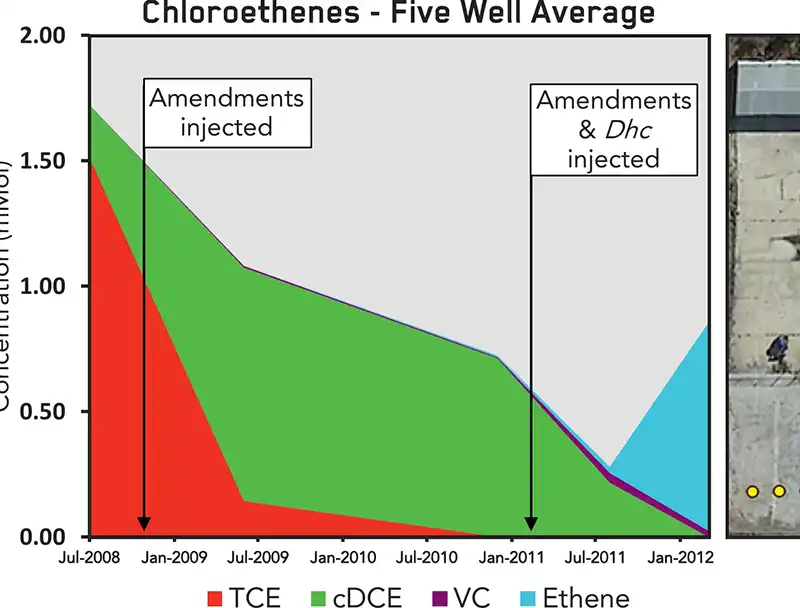
Average concentrations across five monitoring wells show rapid TCE reduction after the initial treatment, followed by cDCE reduction and ethene production after buffer and Dhc bioaugmentation were added.
Injection layout
The injection program used temporary wells throughout the source area and downgradient dissolved plume. Source-area injection wells were concentrated near the apparent release area, while downgradient wells extended treatment beyond the building.
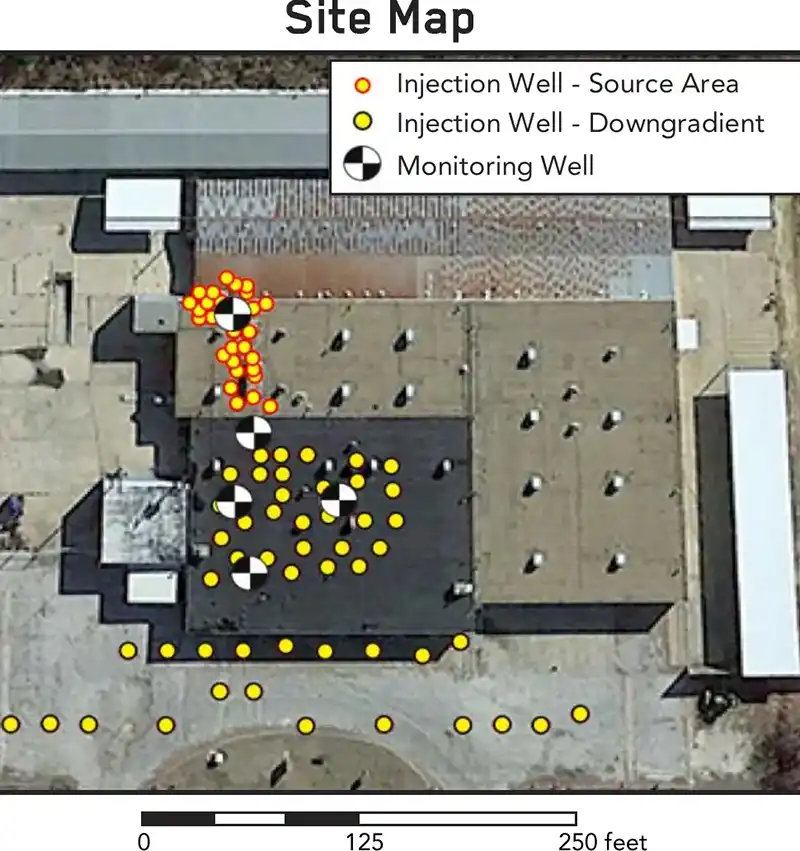
Injection and monitoring-well layout used to address the source area and downgradient TCE plume.
RNAS technical insight
This case study demonstrates that rapid TCE reduction does not necessarily indicate complete treatment. The accumulation of cDCE showed that an electron donor was supporting the initial dechlorination steps, but site conditions did not support complete conversion to ethene.
When degradation stalls at DCE, groundwater pH and the presence of appropriate Dehalococcoides microorganisms should be evaluated. Adjusting site conditions and adding an appropriate bioaugmentation culture can help restore the complete reductive dechlorination pathway.

0 Comments