Newman Zone EVO and Neutral Zone Support Rapid Treatment at a California Mixed-Use Redevelopment Site
A former industrial property in Emeryville, California, was being prepared for commercial, retail, and residential redevelopment. Although soil excavation removed most of the petroleum and metal contamination, significant concentrations of TCE and other chlorinated solvents remained in the soil and groundwater.
The site required a brownfield bioremediation approach that could address PCE, TCE, and their daughter products while overcoming low pH, heterogeneous soils, and contamination concentrated within high-permeability channels.
| Site | Former mixed industrial property in Emeryville, California |
| Planned use | Commercial, retail, and residential development |
| Contaminants | PCE, TCE, and associated daughter products |
| Primary challenges | Low pH, silty-clay soils, preferential flow channels, and a possible upgradient source |
| Products selected | Newman Zone EVO and Neutral Zone |
| Application method | 163 direct-push injection points spaced approximately 15 feet apart |
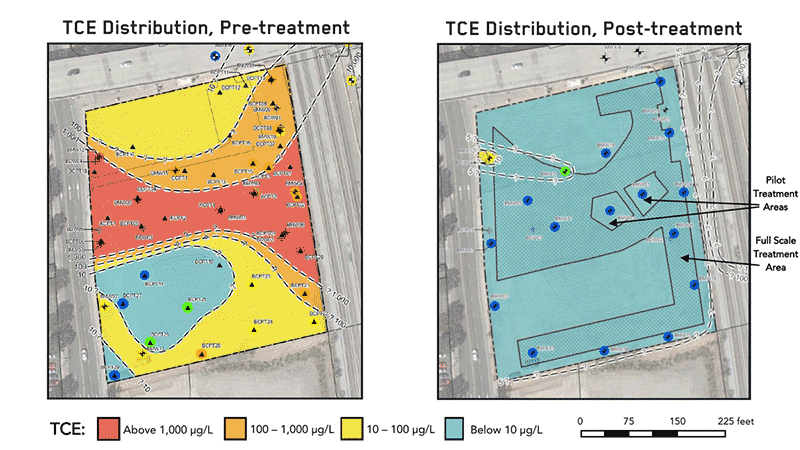
| Results | Average 98% reduction in total chlorinated volatile organic compounds |
Brownfield TCE Bioremediation Challenges
The property had previously been used by rail, oil, and plastics companies. Soil excavation conducted in 2009 removed the majority of the petroleum and metal contamination, but chlorinated solvents remained in both soil and groundwater.
The subsurface consisted primarily of silty clay. Two coarse-grained, high-permeability channels crossed the site below the water table and contained much of the contaminant mass. These channels provided preferential groundwater flow paths and required substantial treatment volumes.
Conditions were further complicated by poor natural buffering across the western third of the site. Pretreatment pH was as low as 5.6 in some areas. Because reductive dechlorination can generate acidity, pH was expected to decline further during treatment unless sufficient buffering was provided.
Site data also indicated that an upgradient, off-site source could be contributing contamination to the dissolved plume and keeping concentrations above water-quality standards.
Pilot Testing the Brownfield Bioremediation Products
Multiple bioremediation products were pilot-tested at two locations to determine the best approach for TCE bioremediation. The testing showed that Newman Zone EVO and Neutral Zone provided the best performance among the products evaluated.
Newman Zone EVO was selected as a slow-release electron donor to provide food for the microorganisms responsible for reductive dechlorination. Its small oil droplets allowed the product to be distributed through the treatment area during injection.
Neutral Zone was selected to compensate for the site’s limited buffering capacity. Maintaining a favorable pH was especially important because Dehalococcoides mccartyi microorganisms responsible for complete dechlorination are sensitive to acidic conditions.
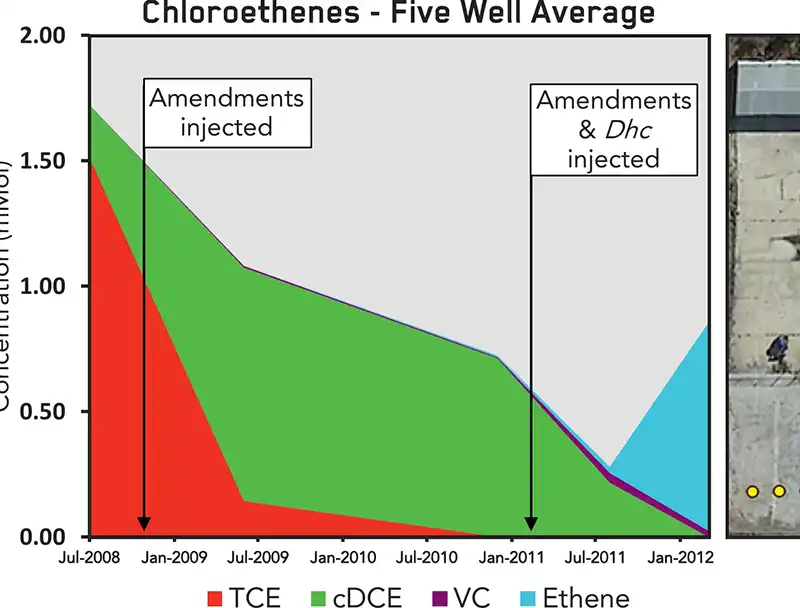
The brownfield bioremediation treatment reduced total chlorinated volatile organic compound concentrations by an average of 98% while maintaining favorable reducing conditions after injection.
Direct-Push Injection Across the Treatment Area
Full-scale treatment was conducted in 2013 using direct-push injections. The injection grid consisted of 163 points spaced approximately 15 feet apart across the treatment area.
Two injection phases were completed. The concentration of Neutral Zone was increased during the second phase to provide additional buffering in the most poorly buffered portions of the site.
Treatment focused particularly on the two high-permeability channels where the most mobile TCE, DCE, and vinyl chloride were located. The direct-push grid allowed Newman Zone EVO and Neutral Zone to be placed within the contaminated zones without installing permanent injection wells.
Brownfield TCE Bioremediation Results
Neutral Zone raised and maintained pH in problematic portions of the site at approximately 6.2. The site-wide average increased to pH 6.7, providing more favorable conditions for the microorganisms involved in complete reductive dechlorination.
Following Newman Zone EVO and Neutral Zone injections, TCE and other chlorinated volatile organic compounds were substantially reduced, with total chlorinated VOC concentrations decreasing by an average of 98%.
The brownfield bioremediation treatment addressed the on-site contamination, but monitoring was expected to continue until the potential upgradient contaminant source could be investigated and addressed.
What This Brownfield TCE Bioremediation Project Demonstrates
This brownfield bioremediation case study shows why product selection must account for both groundwater chemistry and subsurface conditions. Supplying an electron donor alone would not have corrected the low pH that could inhibit complete dechlorination. Buffering without an appropriate electron donor would not have supplied the sustained food needed by the microbial community.
Pilot testing helped identify a compatible combination of electron donor and buffer before full-scale application. The injection design then focused treatment on the preferential flow channels containing much of the mobile contaminant mass.
By combining Newman Zone EVO with Neutral Zone and distributing the products through a carefully planned direct-push injection grid, the project successfully treated TCE and related chlorinated solvents, achieving a 98% average reduction in total chlorinated volatile organic compounds despite difficult site conditions.

0 Comments